

Louise Bouman, Chair of Stichting Pulmonale Hypertensie (PHA Netherlands) and Board Member of the Alliance for Pulmonary Hypertension is just back from Amsterdam where she attended the Pulmonary Vascular Institute (PVRI) Symposium on Drug Discovery and Development taking place on June 16-17.
“I recently had the opportunity to attend an inspiring symposium organized by the Pulmonary Vascular Research Institute (PVRI). The program featured insightful talks on advances in drug research and development in the pulmonary vascular field. Beyond the scientific content, it was a great chance to connect with passionate professionals from around the world. The discussions and perspectives I gained will certainly inform my work moving forward. Many thanks to the speakers, organizers, and fellow participants for this valuable experience!”
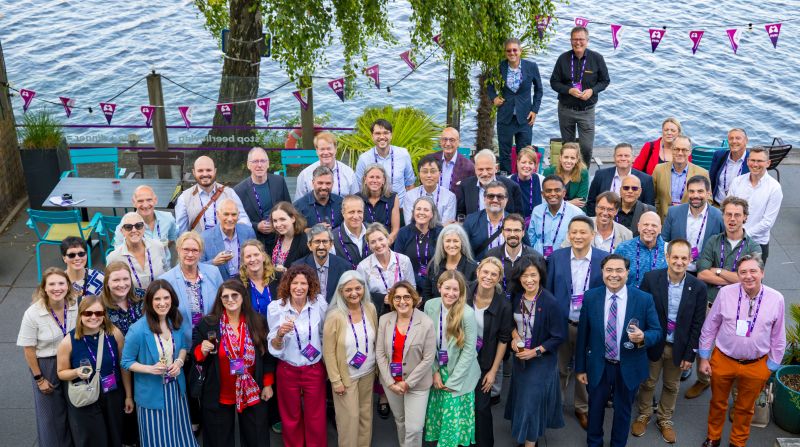
Louise is in the front row, fourth from left, in this group photo, see below (photo credit PVRI).
Read Louise Bouman’s report here:
Read the AI generated summary below.
This report is translatable in 40 languages with the embedded plug-in:
PVRI DRUG DISCOVERY AND DEVELOPMENT SYMPOSIUM, AMSTERDAM, JUNE 16-17, 2025
This conference focused on recent advances in research and treatment of pulmonary arterial hypertension (PAH).
SESSION 1: NEW STANDARDS OF CARE
1.1 Sotatercept: A Game Changer
Sotatercept has received regulatory approval from both EMA and FDA as the first “remodeling” drug for PAH.
Illiana Meurs (CBG-MEB, Dutch Medicine Evaluation Board) presented the EMA perspective, highlighting that a 24-week placebo-controlled trial showed:
- 41-meter improvement in six-minute walk distance
- Reduction in pulmonary vascular resistance and NT-proBNP
- Good tolerability with manageable side effects
- Final approved indication narrowed to improving exercise capacity only
- Required combination use with other PAH therapies
Mitchell Psotka (FDA) discussed the FDA approval process, emphasizing that the primary endpoint of 41-meter improvement was both statistically and clinically significant. The final indication stated sotatercept improves exercise capacity and functional class in pulmonary arterial hypertension.
1.2 Changes in Treatment Algorithms
Luke Howard (Imperial College London) explored how sotatercept will change treatment algorithms, noting the evolving focus toward remission and hemodynamic improvements, though regulators remain cautious about accepting pulmonary vascular resistance (PVR) as a primary endpoint.
Marion Delcroix (UZ Leuven) discussed implications for drug development, highlighting sotatercept’s positioning within intermediate and high-risk treatment categories and growing interest in treatment de-escalation.
SESSION 2: DISEASE MODIFICATION
2.1 Defining Disease Modification
Mark Toshner (University of Cambridge) emphasized the need for longitudinal, patient-centric outcomes rather than just symptom relief. A poll has revealed low consensus, with only 30% viewing immunomodulatory drugs as disease-modifying. He stressed that patients must be involved in defining disease modification goals.
2.2 Role of Imaging
Sudarshan Rajagopal (Duke University School of Medicine) explored how cardiac Magnetic Resonance Imaging (MRI) and echocardiography can support disease modification assessment. While cardiac Magnetic Resonance Imaging was highlighted as superior to echo for predictive accuracy, imaging is not yet recognized by regulators as a validated marker of disease modification.
SESSION 3: DIVERSITY AND INCLUSION
3.1 Sex Differences
Deimante Hoppenot (Lithuanian University of Health Sciences) addressed critical sex differences in pulmonary arterial hypertension. Although females are more frequently affected, they have better survival rates than males. Despite clear evidence, sex is not currently considered in pulmonary arterial hypertension treatment guidelines.
3.2 Underrepresented Populations
Cati Brown-Johnson (Stanford University School of Medicine) presented the TOTAL trial, showing that Black Americans are significantly underrepresented (3.2%) while Asian Americans are overrepresented (19.3%) in pulmonary hypertension. clinical trials. The trial tests diversity-enhancing recruitment strategies including community ambassadors and social media outreach.
SESSION 4: GLOBAL ASPECTS
4.1 Registry Data for Global Trials
Werner Seeger (Justus Liebig University Giessen) presented the Go Deep registry with participation from 47 centers, revealing key findings including better survival in females and a surprising “systemic arterial hypertension paradox” where pulmonary arterial hypertension. patients with systemic hypertension had lower hazard ratios.
4.2 Access vs. Discovery Debate
Anna Hemnes (Vanderbilt University Medical Center) argued pro-access: “Innovation is vital, but without access, it has no impact—availability is what ultimately saves lives.”
Ardeschir Ghofrani (University Hospital Giessen) argued pro-discovery: “Discovery fuels access, not the other way around. Without ongoing research, the pipeline dries up. Innovation and access are twins, not opposing goals.”
SESSION 5: INNOVATIONS IN TRIAL DESIGN
5.1 Risk Scores and Endpoints
Athenais Boucly (Paris Saclay University) examined how risk scores like REVEAL 2.0 are used for patient selection and enrichment in trials, though risk scores are not yet validated surrogate endpoints.
David Kiely (University of Sheffield) focused on imaging as surrogate endpoints, confirming cMRI’s predictive value through meta-analysis of 20 studies with 2,000 patients.
5.2 Novel Approaches
Martin Wilkins (Imperial College London) advocated for n-of-one (N1)studies using implantable devices and remote monitoring for individualized treatment optimization.
Alex Rothman (University of Sheffield) discussed Bayesian statistics and hierarchical endpoint analysis to better capture treatment effects and individual variability.
Harm Jan Bogaard (Amsterdam UMC) addressed ethical aspects of open-label extension studies, noting they offer benefits but raise concerns about clinical equipoise and selection bias.
5.3 Environmental Impact
Frances Varian (University of Sheffield) emphasized reducing clinical trials’ carbon footprint (~100 million tons CO₂ annually), advocating for digitization and decentralized designs to cut emissions by 20-30%.
SESSION 6: NOVEL DRUG & DEVICE THERAPIES
6.1 Emerging Drug Therapies
Zhi-Cheng Jing (Guangdong Provincial People’s Hospital) presented spermine-mediated metabolic reprogramming research, developing compound M2 that showed promise in reducing pulmonary hypertension in animal studies.
Rohan Zamainian (Vera Moulton Wall Center and Stanford) introduced Elephin (Prilostat), a neutrophil elastase inhibitor moving to the Athena study with 90 pulmonary arterial hypertension patients.
Paul Yu (Harvard Medical School) discussed BMP9 pathway targeting, with a new anti-BMP9 antibody currently in phase 2 trials.
Pilar Escribano Subias (Hospital Universitario 12 de Octubre) presented Seralutinib results showing 24% reduction in pulmonary pressure with no serious side effects, leading to the PROSERA phase 3 trial.
Ardeschir Ghofrani (University Hospital Giessen) shared Mosliciguat data demonstrating 36-38% reduction in lung pressure without systemic hypotension, with a larger Phase 2 trial planned.
6.2 Device Innovations
Marc Pritzker (University of Minnesota) introduced the Aria Device – both mechanical devices for pulmonary vessel assistance (showing 47-meter improvement in walk distance) and neuromodulation devices using vagus nerve stimulation.
Alex Rothman (University of Sheffield) presented pulmonary artery denervation results from 23 patients showing lower pulmonary pressure, improved exercise capacity, and better quality of life.
Future Outlook and conclusions
The conference highlighted a rapidly evolving field moving toward:
- Precision medicine and personalized treatments
- Better definition of remission in pulmonary arterial hypertension.
- Improved inclusion of underrepresented patients
- More environmentally sustainable clinical trials
- Combination therapies targeting multiple disease aspects
- Integration of AI and big data for better patient outcomes
While significant challenges remain, the future of pulmonary arterial hypertension treatment is promising, with multiple innovative therapies from leading researchers worldwide that could transform patient outcomes.
Read the AI generated key emerging themes from this symposium
This report is translatable in 40 languages with the embedded plug-in:
1. Paradigm Shift: From Symptom Management to Disease Modification
The biggest change is moving beyond just treating symptoms to actually modifying the disease course. Sotatercept represents the first “remodeling” drug, and researchers are now seriously discussing remission as a treatment goal – something previously unthinkable in PAH.
2. The Sotatercept Era Begins
This is the first new class of PAH drug in years, and it’s changing everything:
- First regulatory-approved “disease-modifying” therapy
- Forces a complete rethink of treatment algorithms
- Sets new expectations for what future drugs should achieve
- Opens the door for combination approaches and potential treatment de-escalation
3. Pipeline Explosion of Innovative Therapies
Multiple promising treatments are advancing simultaneously:
- Inhaled therapies (Seralutinib, Mosliciguat) showing 24-38% pressure reductions
- Novel targets (BMP9, spermine metabolism, neutrophil elastase)
- Device-based approaches (pulmonary artery denervation, mechanical devices)
- This suggests PAH treatment could be transformed within 5-10 years
4. Precision Medicine is Arriving
- N=1 studies using implantable devices for personalized treatment
- Risk stratification to identify likely responders
- AI-enhanced imaging for better patient selection
- Sex-specific considerations finally being recognized
5. Major Equity and Access Challenges
Despite medical advances, there are serious disparities:
- Racial/ethnic underrepresentation in trials (Black Americans only 3.2%)
- Global access problems even in wealthy countries
- Tension between innovation funding and ensuring patients can actually access treatments
6. Methodological Revolution in Clinical Trials
- Environmental sustainability becoming a real consideration
- Bayesian statistics and win ratios replacing traditional approaches
- Imaging endpoints gaining acceptance as surrogate markers
- Decentralized trials reducing patient burden and emissions
7. The “Remission” Question
Perhaps most fundamentally, the field is grappling with: Can we actually cure pulmonary arterial hypertension, or at least achieve sustained remission? This wasn’t seriously discussed just a few years ago, but now:
- Hemodynamic normalization is being studied
- Treatment withdrawal trials are being planned
- Patient-defined remission goals are being incorporated
Bottom Line
This conference suggests pulmonary arterial hypertension is at an inflection point. We’re moving from a era of “managing a chronic disease” to potentially “achieving remission or cure.” The combination of new drug classes, device innovations, precision medicine approaches, and paradigm shifts in treatment goals could fundamentally transform outcomes for pulmonary arterial hypertension patients within the next decade.
The challenge now is ensuring these advances reach all patients who need them, not just those in wealthy countries or well-represented demographic groups.