

My name is Derek Henderson. I live in Toronto, Canada. The title of my talk is what I would tell my newly diagnosed CTEPH (chronic thromboembolic pulmonary hypertension) self. And this is a letter I wish I could have sent myself back through time about 15 odd years ago when I was diagnosed with the condition. So I’m just going to talk a little bit about me.
This is a picture of myself and my wife, Hailey. I’m a programmer.
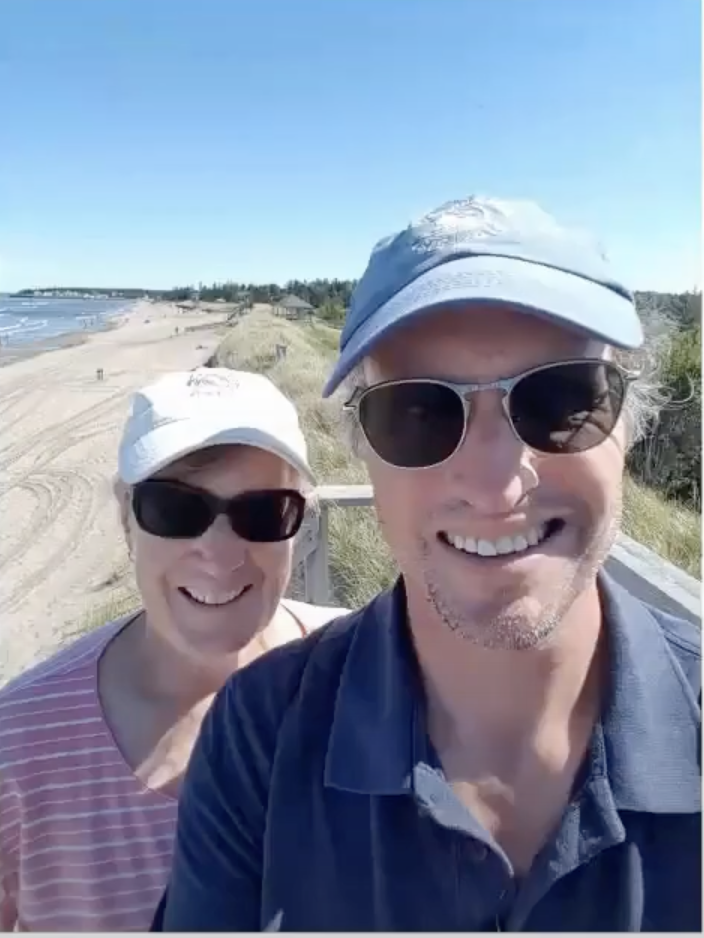
I am fairly active. I try to do about 45 minutes to one hour of cardio exercise a day. I have no medical background. I’m a web developer. And my experience is about my chronic thromboembolic pulmonary hypertension journey in Canada. And one thing to keep in mind for people that some don’t have, Canada has socialized medicine, so there’s not a cost to it directly. We pay it through our taxes and we can pretty well go anywhere we want. The only thing is there’s sometimes a bit of a wait for stuff.
So my story started with me not being able to bike. I normally bike about 60, 100 kilometers or 60 miles a week during the warmer weather.
What ended up happening to me is that over time, and this is over a couple of years, my speed went down and I started noticing that my route would take longer and longer and longer. I had my bike checked. It was fine. It was nothing to do with the bike. It was me. I did go to the doctor a few times, which I’ll talk about in a few minutes, but there was nothing ever conclusive. I was diagnosed in October 2012 and I had pulmonary thrombectomy (PTE) or pulmonary endarterectomy (PEA) as it is sometimes called surgery in 2013. As of now, I’m fine. I’ve had a few detours along the way, but I’m fine. I am on blood thinners for life, but there really has no impact on my journey, on my day-to-day life.
This is a picture of me in the hospital just after I was diagnosed in 2012.
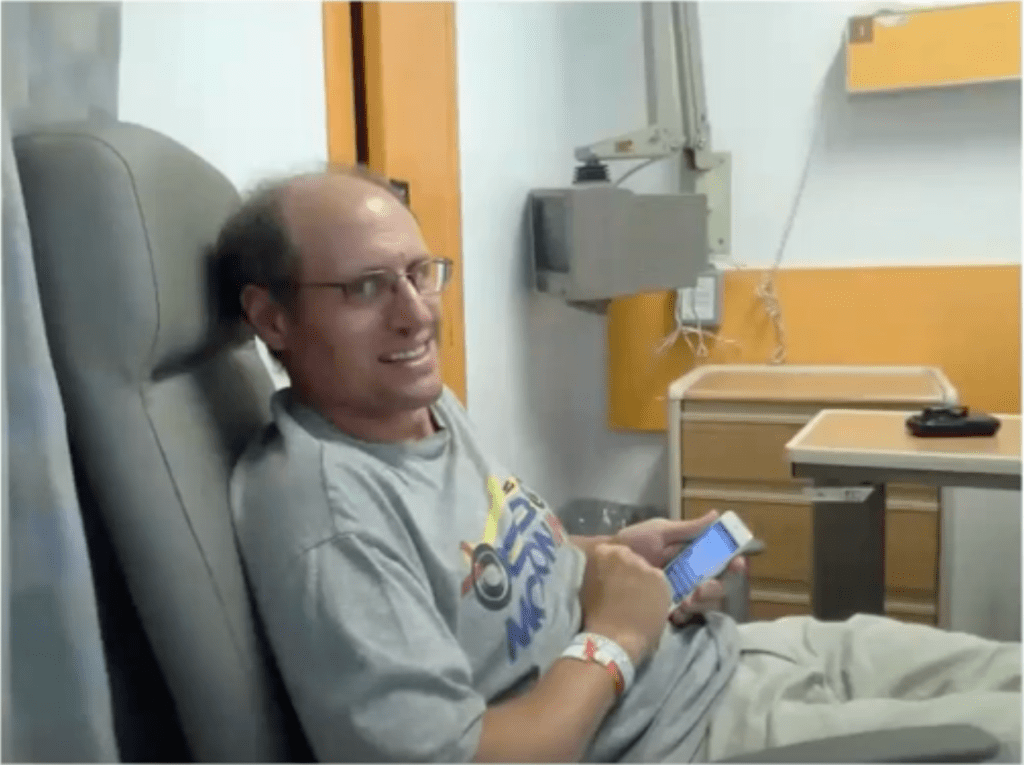
It may not look it but I can’t really walk too well at this point. And my right heart is quite enlarged at this point. So it just shows that you can’t really tell how anybody looks when you get sick with a form of pulmonary hypertension.
So when you get a diagnosis, I think the one thing you have to think about is that you should be happy about it. It sounds strange to be happy, to be diagnosed with a critical illness or long-term illness. But the thing is about pulmonary hypertension or any of its forms is that it’s hard to get it diagnosed right the first time. A lot of times it’s misdiagnosed. I was misdiagnosed with pneumonia a couple of times and also given a puffer. And a few times they said, “Must be allergies or something else.” Once you’re diagnosed with it, you know what it is. You can focus your energy on it. You can tell people what it is and you know what the enemy is and you have a definitive diagnosis so you can tell your circle of trust about it. So it makes it a lot easier once you know about it.
So much as it sounds stupid and it sounds hard to believe, you should be happy that you actually have a diagnosis of something. But the downside is that when you have a diagnosis, you start looking things up on the internet. And when I was diagnosed in 2012, the internet wasn’t any other year as big as it is now, but now you can look things up and you can go down all these bad roads.
And the one thing I’ll say is that as you can see this slide here, things you worry about happening, things that can happen and things that actually do happen. So what I would tell myself is just to focus on your step, your current step, and your next step. Don’t go down too many roads. The internet is full of horror stories. It’s full of a lot of good stories too, but you just have to be patient and just look at where you are in your diagnosis and in your journey. The first thing you find out is that when you get diagnosis with something like this, is that you have all kinds of terms that you have to learn, INR, right heart pressures, blood work.
It becomes overwhelming. So it’s almost like starting a master’s degree. And I have this term, “if you’re going to be a duck, you have to learn duck”. You almost have to learn a new language and you have to learn what all those terms mean. You have to learn when to be concerned, when not to be, and it’s going to take some time to do that. One thing that I had that was great was to have a book and write down what was said in doctor’s appointments and technician’s appointments, and then any questions I had afterwards so that I could write down any questions my family had afterwards and find out the answers. Because there were times for me when I was going through this, things were just a bit much, so I wasn’t able to relate to things I could have.
You will need an advocate for you. Someone to take care of you. In Canada, the medical system does a great job of taking care of you, but it doesn’t help with some of the psychological or some of the non-immediate tasks. So in my case, my wife was able to admin as an advocate for me. Haley went with me at most medical appointments. She could listen to things and write down things that I might have missed. She was able to ask doctors questions from her side of things. And again, just someone that’s not dealing with how to take care of you and stuff. It’s not always your spouse that’s the best person. Sometimes spouses are not the best people to help, and pulmonary hypertension does put a burden on spousal relationships and friendships. So it’s not always your spouse. In my case, it was.
I was very lucky with Haley. She had just finished her own journey with cancer, so we both knew the … She helped me with the medical system in Canada. And sometimes, again, because of socialized medicine, you have to have an advocate there to help push things along. And in a couple of cases I can go to ombudsman at a hospital to try to get some feedback from doctors and get some prescriptions filled and stuff. So it helps to have an advocate to make sure that you’re being taken care of.
One of the biggest things I would tell myself is that you have to have patience. You didn’t get sick overnight, you’re not going to get better than me. When I was diagnosed, I went to the hospital. I was hoping to just get the needle and come home and be done with it. It took a year, if not longer, to get completely better. And I didn’t realize it was a lifetime condition. There’s lots of appointments, lots of waiting. Again, I live in Canada with socialized medicine, so I’m waiting on time home for a five-minute meeting with a doctor for four hours. You just have to have patience, bring books or videos or whatever with you. Just be patient. It’s just going to take lots of time to do that.
Some people are donkeys, and this is a picture of me. I go to Venier, which is my Caribbean every year, Donkey Sanctuary. So it’s me feeling donkeys. And I always think of this as some of the people that I dealt with when I’m sick. Some people and employers are donkeys. Pulmonary hypertension and blood clots do not evoke the same fear as cancer. So it should evoke the same fear as cancer, but it does’nt. So people sometimes just don’t get it. I was told repeatedly that I don’t look sick and the employer questioned me why I was taking so much time off work, why I was tired all the time. And there’s only so much you can tell people, and some people just don’t accept it. And so it’s one thing you have to learn, some people just won’t understand it. So you just have to accept it.
Another thing I would tell myself is that you have to celebrate your success as you go through the journey, even if it’s just going up and down an extra flight of stairs in a day. A lot of times, especially when I was newly diagnosed, I kept a log or journal, if you want to call it that. And if I got an extra flight of stairs or a day or something like that, I’d treat myself to something whether it was an extra piece of a Sunday or an extra drink or a night out or whatever.
But sometimes it doesn’t go on a straight line. There are setbacks sometimes when you went through this journey. So that’s one of the biggest things I’ve learned. My wife and I take a trip every year to celebrate the fact that we both have made it through another year, and that’s a separate trip we started taking to celebrate at the end of her cancer.
And then a couple of years later ended up joining myself. I ended up celebrating it as well to celebrate money and recovery from pulmonary hyeprtension. So I think it’s important to celebrate your successes, to enjoy the gift of perspective. The disease teaches you what is important. You certainly have to learn to take, to not worry about some things as much as you may have before. Getting these reports done for work isn’t always important.
You have to just try to have some fun and enjoy yourself and enjoy life. And it is, to say it’s life-changing, it may be a stretch, but it certainly will impact your life and impact your view of life and to try to keep having fun. That’s one of the biggest things that I do now is I try to make sure I have some fun as much as possible.
This is a picture of a sunset off of, again, a safe and air every year. And this is one of the things I look forward to every year, so I try to make sure I have some fun of year and try to enjoy the sunsets.
So that concludes what my talk, and I hope that this helps people when they get diagnosed with any form of pulmonary hypertension. It’s just hopefully a bit of a guide and helpful tips to get through and just realize that you’re not alone and there’s a lot of good people in this group that will help, but just take your time and patient, enjoy yourself.
If you have any questions, feel free to contact me through the website, and that’s it.