

Hello everyone. Welcome to another session of Patients Empowering Patients PEP Talks Program. My name is Değer Kesimoğlu and I’m 71 years old. I’m a member of the Pulmonary Hypertension and Scleroderma Patients Association in Turkey. And we are proud to be a member of the Alliance for Pulmonary Hypotension. And I am a volunteer for this group. I was diagnosed in 2018 with idiopathic pulmonary arterial hypertension. Unfortunately, the cause of this form of pulmonary hypertension is not yet known. Pulmonary arterial hypertension is a chronic disease that needs ongoing care and attention. And while it cannot be cured for the moment, I’m happy to say that with each new medication, we’re gaining more time and hope. In fact, every new drug gives us another 10 years to look forward to. Looking ahead, we know there are several promising treatments on the horizon and one actually has entered in limited use. So yes, we’ll definitely be around for some more time. 🙂
Today, I would like to share my personal experience with my treatment, how I manage my medications and cope with the side effects, and offer some tips that have been helpful along to me along the way.
By sharing these insights, I hope to be an example to other patients so that they can learn from each other’s journeys and build a supportive community. If we go on to my treatment journey, I’d like to start with how it started.
Pulmonary arterial hypertension patients who are expected to benefit more are put on a combination of medications rather than just one or two. This is called a combination therapy. In my case, since I fall into intermediate or high risk group, I am on triple oral combination therapy. This means I take three medications by mouth. The medications we take require a special prescription. As for the medications, it’s macitentan, I’ll start with. When I was first diagnosed, I was prescribed macitentan with the single pill I took daily. I noticed an improvement in my walking speed. I could walk slightly longer distances without having to stop. But I was advised to take this medication very regularly.
Although side effects like back pain or muscle ache could be experienced, I was fortunate enough not to have any. To prevent edema, swelling, I was also advised to limit salty fluids and drink more water. So far, so good. No problems with this one.
Six months later, following a detailed checkup, I started taking tadalafil as two doses per day. I found it difficult to have to rely on my medication, but I was strong and a good patient. They were doing me good. Unfortunately, at this stage, I tended to vomit from time to time.
A year later, I was prescribed selexipag and its use proved to be a significant challenge in my daily life. During the up titration period, when the dosage was gradually increased, the common side effects closely affected me. I would lie awake, cramped up with intense muscle and joint pain. In the morning, just opening my mouth to eat something, I sometimes had this sharp jaw pain. My maximum dosage, which is 3,200 mcg per day, was reached sticking to the instructions on the prospectus leaflet. When the headache was about to start, my face sort of flushed. As for the diarrhea, I still take antidiarrheal medicine if I wish to leave home for the day. But actually, I believe the challenges as I experienced with selexipag were partially due to my age, I would stay. However, I could not stay home and I wished to go out.
So I started taking my medication with a piece of bread, which actually helped. Whenever I felt my face flushing, I knew a headache was imminent, so I would drink a bit of water. If that didn’t help, then it was time for a painkiller. The side effects that were strong during the uptitration period have actually improved greatly. They say “after the storm comes the calm”.
Yes. But of course, however, even though I have been using selexipag for more than six years, I still suffer from headache, backache, and diarrhea. If it is to be a long day, I sometimes wear adult nappies just to be safe. Usually nothing happens, but at least I don’t have to panic. I always carry a painkiller in my bag. As for the occasional jaw pain, I just move my jaw up and down, opening and closing my mouth before I eat something. The side effects of my combined therapy present some difficulties. That’s true.
But when I reflect on the improvements in my health, a smile naturally appears in my face. Moreover, with the new medication on the horizon, there’s hope for even better management of our condition.
I have made some, or there has been some lifestyle adjustments as well. The first one is eating slowly, and that’s a personal tip. When you are eating, I recommend taking very small bites, swallow each bite and wait for a moment before taking the next mouthfall. In my experience, if I rush, I tend to feel nauseous. And so please take your time and eat very slowly savoring, let’s say, each bite. It’s not just like grabbing a quick sandwich, especially when eating bread goes slowly. The consequences of hurrying can make you lose time, actually. I have also been prescribed diuretics to manage edema.
We go on to breathing exercises and TriFlow, my breathing companion (TriFlow is a type of incentive spirometer with three color-coded balls in separate chambers used to help patients practice deep, slow breathing to improve lung capacity and function, especially after surgery, by visually indicating inhalation effort and guiding proper air volume).
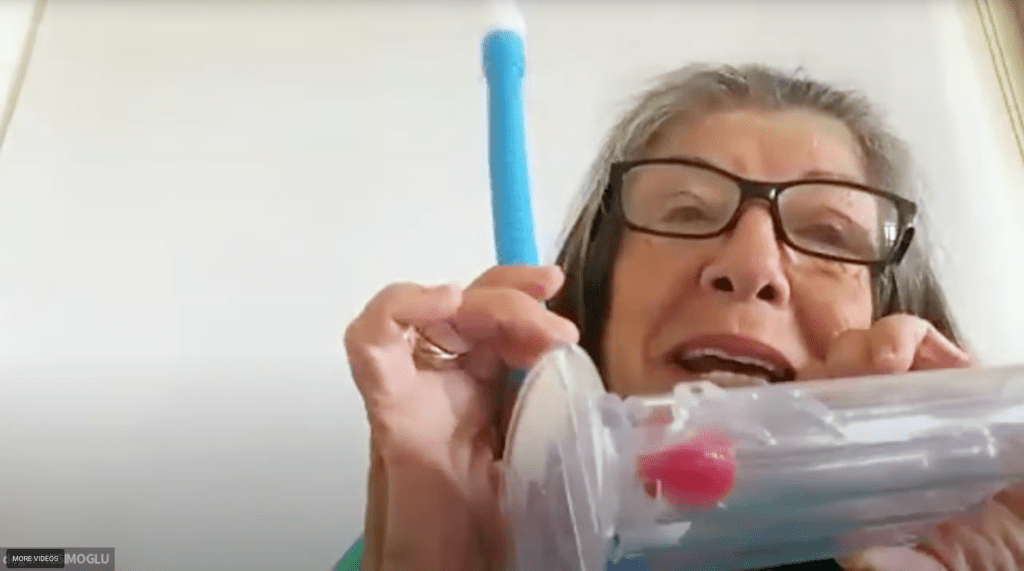
Our medication is crucial for our treatment. However, the importance of TriFlow is undeniable. It strengthens respiratory muscles and reduces shortness of breath breath. I use it for two different exercises. The goal is to raise the balls in all three sections to the top. Moving the ball in the first section requires minimum training. However, getting all three balls to the top necessitates constant practice. Please don’t give up. It takes time. Continue exercising a few times a day until you can move all of them. Once achieved, maintain your practice by using it occasionally to prevent losing progress. It’s not like by riding a bike.
Staying on top of your medication, your health, your schedule, book your next checkup. In Turkey, medications for pulmonary arterial hypertension are provided through a medical certificate issued by state hospitals with a pulmonary hypertension department.
Every three months, patients undergo comprehensive checkups before receiving a new supply of medication. It’s crucial to keep track of your medication schedule and the application process for a new medical certificate.
Due to high demand, doctor’s appointments are often fully booked. So it’s advisable to book an appointment at least 15 days before your current medical certificate expires.
Then we go onto my pill boxes, my lovely pill boxes. There they are. I maintain a strict control over my medications. Once a month, usually at the weekends, I prepare four boxes each divided into seven daily compartments. So I also keep an additional three week supply on hand for emergencies. The four boxes I prepare help me keep track of how much I have left and remind me when it’s time to get a new prescription. These boxes are the most important things in my home. They’re the first things to be saved in case of an emergency.

For pulmonary arterial hypertension patients, it’s very important to follow the prescribed medication schedule medically. If a dose is missed and there’s less than a three hour gap before the next one, you can take the missed dose. If more than three hours have passed, just continue with the next dose as scheduled. Empowering our journey, strength, support, and shared wisdom.
I’d like to express my profound gratitude to the forces that keep me going. First, to the treatment I’m undergoing, the medications that are essential in restoring my health, then to the team of physicians who guide me through my journey with their utmost care, to my family who are always there to support me every step of the way. And last but not least, to the Alliance for Pulmonary Hypertension for devising such a meaningful program, giving us the the chance to share our experiences with you.
In closing, I hope you have found a tip or two that might help you with on your journey. Remember, every small step makes a difference. Medications are just part of our routine, are not just part of our routine. They are essential to our survival. Together, we can face the path with strength, hope, and the commitment to our health. Thank you.