

A retrospective study by researchers in Turkey looked at a simple index based on three routine blood measurements: platelets, albumin and bilirubin. The “PALBI” index reflects how pulmonary hypertension affects both the heart and the liver. Researchers applied it to 3,432 people, including 1,520 patients with pulmonary hypertension identified by echocardiography. The final cohort comprised 105 patients in Group I of the World Health Organisation (WHO classification, 735 in Group II, 605 in Group III, and 75 in Group IV.
Patients had higher scores than healthy people, and the index distinguished between the two groups better than standard markers of inflammation. Within one year, 21.5% of patients died and 36.4% were hospitalised for heart failure. Higher scores independently predicted both outcomes. Combining the index with N-terminal pro-B-type natriuretic peptide improved the prediction of death, and adding it to an established risk score improved the assessment of patients with pulmonary arterial hypertension.
In Group I pulmonary hypertension, the AUC for the combination of PALBI+REVEAL risk score was 0.064 higher than that for the REVEAL risk score alone (P<0.05).
The authors conclude that it is a reliable, low-cost tool for predicting short-term outcomes.
Read more at this link on the Circulation Journal
Citation
Mehmet A. Gelen, Görkem Yıldız, Hasan A. Bolayır, Mehdi Karasu, Yusuf Akın, İlker Özer, Platelet–Albumin–Bilirubin Index for Predicting Hospitalization and Mortality in Pulmonary Hypertension, Circulation Journal, 2026, Volume 90, ssue 11, Pages 1715-1726, Released on J-STAGE October 23, 2026, Advance online publication September 30, 2026, Online ISSN 1347-4820, Print ISSN 1346-9843, https://doi.org/10.1253/circj.CJ-26-0436,https://www.jstage.jst.go.jp/article/circj/90/11/90_CJ-26-0436/_article/-char/en
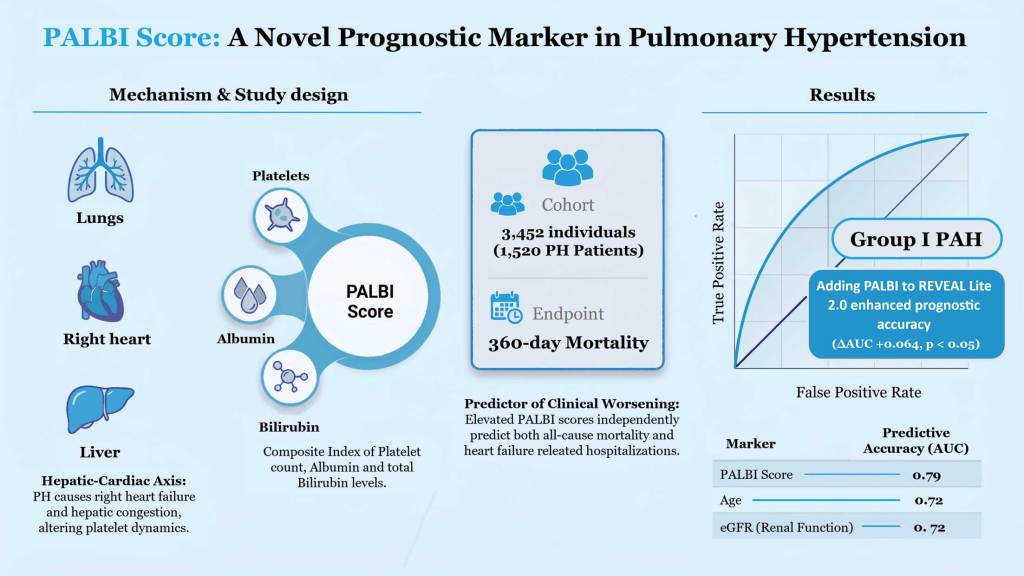
Photo credit: Circulation Journal https://www.jstage.jst.go.jp/pub/circj/90/11/90_CJ-26-0436/figure/90_CJ-26-0436.jpg
