INTRODUCTION
Ever wondered how we went from completely misunderstanding blood flow for 1,400 years to performing open-heart surgery? A fascinating historical review by Prof. Adam Torbicki, published in Diagnostics (2021), reminds us that while most modern clinicians “look forward, expecting new pathophysiological pathways to be explored,” few take time “to look into the past.” Yet this past is filled with incredible stories of courage, discovery, and sometimes tragedy.
While this article is not recent, it’s still a great read that shows us how we got to where we are today. From Galen’s 14-century reign of incorrect theories, to Miguel Serveto being burned at the stake in 1553 (the same year he correctly described pulmonary circulation!), to Ibn al-Nafis’s brilliant insights from 1232 that went unrecognized for 700 years—the path to understanding how blood flows through our lungs is as dramatic as any medical thriller.
The journey culminates with John Gibbon’s heart-lung machine in 1953, proving that sometimes looking back helps us appreciate just how far we’ve come—and reminds us that today’s “impossible” ideas might be tomorrow’s breakthroughs.
Sometimes the most innovative thing we can do is remember that every established truth was once a revolutionary idea. 💡
Ancient Foundations
The journey begins with early concepts from ancient China (Nei Ching, 2900 BC) and Egypt (Edwin Smith papyrus, 1600 BC) that recognized blood circulation and pulsatile flow, though these insights weren’t widely applied.
Galen’s Dominant Theory
For 14 centuries, medicine was dominated by Galen of Pergamon’s (129-207 AD) incorrect theory that blood was produced by the liver, heated by the heart while passing through pores in the heart’s septum, mixed with air from the lungs, and then consumed by tissues—essentially treating blood as expendable rather than circulating.
Renaissance Breakthroughs
The Renaissance brought crucial discoveries:
- Andreas Vesalius (1514-1564) used human autopsies to disprove Galen’s anatomical errors, including the non-existent pores between heart ventricles
- Miguel Serveto (1511-1553) made the first accurate description of pulmonary circulation, recognizing that blood travels from the right ventricle through the lungs before returning to the left ventricle. Tragically, he was burned at the stake for his theological views the same year his circulation theory was published
- William Harvey (1578-1657) finally completed the picture in 1628, proving that blood circulates throughout the body and is reused rather than consumed
The Overlooked Middle East
The article highlights that Ibn al-Nafis, a Syrian scientist, had accurately described pulmonary circulation in 1232—over 300 years before European scientists. His work remained unknown to Western medicine until the 1930s.
Modern Developments
The understanding of pulmonary circulation led to:
- Recognition of pulmonary hypertension syndromes in the late 1800s: Ernst von Romberg, a German physician, made what is considered the first description of “primary” or idiopathic pulmonary hypertension in 1891 when he found unexplained sclerosis of pulmonary arteries during autopsy, unable to identify any underlying disease that could cause it
- Development of right heart catheterization (Nobel Prize awarded to Forssmann, Cournand, and Richards in 1956)
- Creation of the heart-lung machine by John Gibbon, first successfully used in 1953
Key Message
This story illustrates how our current understanding of pulmonary circulation—fundamental to modern cardiology and cardiac surgery—emerged through centuries of gradual discovery, often challenged by prevailing beliefs and institutional resistance. It concludes with Ibn al-Nafis’s wise words: “When hearing something unusual, do not preemptively reject it, for that would be folly… Truth is truth unto itself, not because many people say it is.”
Downlad the full article here.
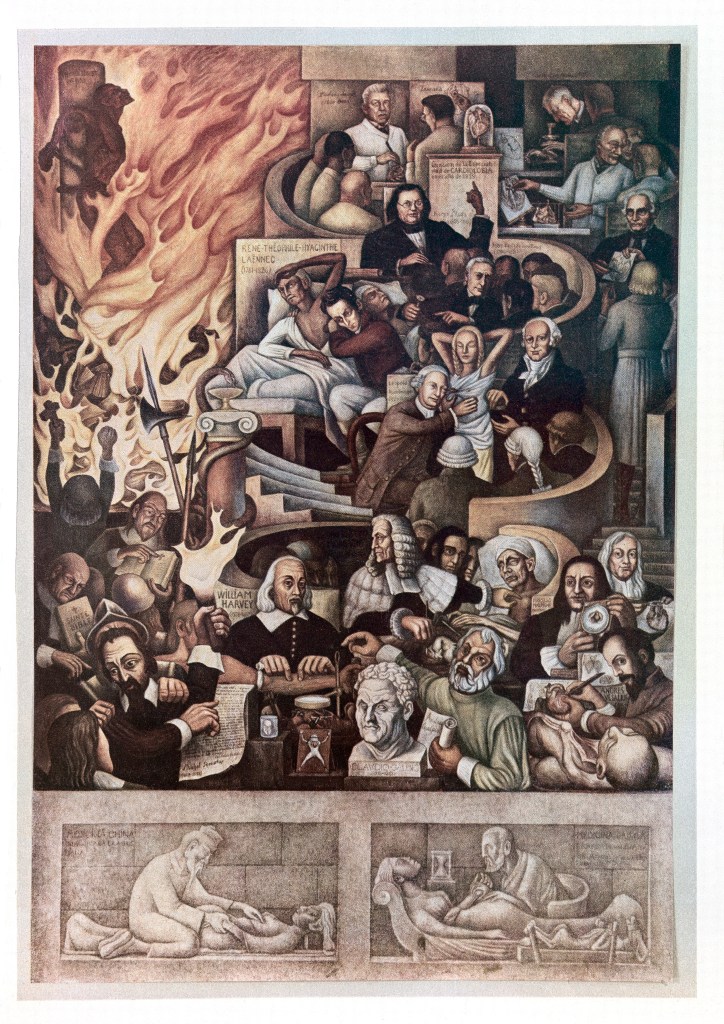
About this image: This is Diego Rivera’s famous mural “History of Cardiological Doctrines,” painted in 1946 for the Instituto Nacional de Cardiología in Mexico City.
The mural depicts the evolution of cardiovascular knowledge through history, featuring key figures including Galen, Vesalius, Harvey, Malpighi, and notably Miguel Serveto—who appears alongside the symbolic burning stake that claimed his life in 1553, the same year he published his correct theory of pulmonary circulation. When commissioning this work, the institute’s director, Professor Ignacio Chavez, specifically asked Rivera to capture not just the “ascending trend of knowledge” but also “how slow and difficult the advance has been” and “how each of those men had to fight routine, prejudice, ignorance and fanaticism.”