

Lukáš Jakovec set off from Udine, Italy, on 11 October 2025 — a trip he had been planning for over seven years. Two hundred and thirty days and 22,000 km later, with a total elevation gain of roughly 144,000 metres, he rolled into Prague, his home town. Along the way he looped through Italy, including San Marino and the Vatican, Monaco, the French and Spanish coasts, dipped to the edge of Gibraltar, traced the Portuguese coast and the Camino to Santiago de Compostela, then turned north through Belgium, the Netherlands, Germany and the Danish border before following the Elbe home. Throughout, he carried one message for the Alliance for Pulmonary Hypertension-backed campaign: organ donation and transplantation save lives. Read the full details of the campaign at this link
Lukáš kept a daily diary throughout his journey — vivid, personal, and full of the people he met, the kindness of strangers, the landscapes he crossed, and the moments that made the ride worthwhile. Illustrated with his own photographs taken along the way, it is a remarkable document of 230 days on the road. You can read it in pdf format below.
THE OFFICIAL CLOSING CEREMONY TOOK PLACE WHERE THE CAMPAIGN STARTED, IN UDINE, ON JUNE 30, 2026!
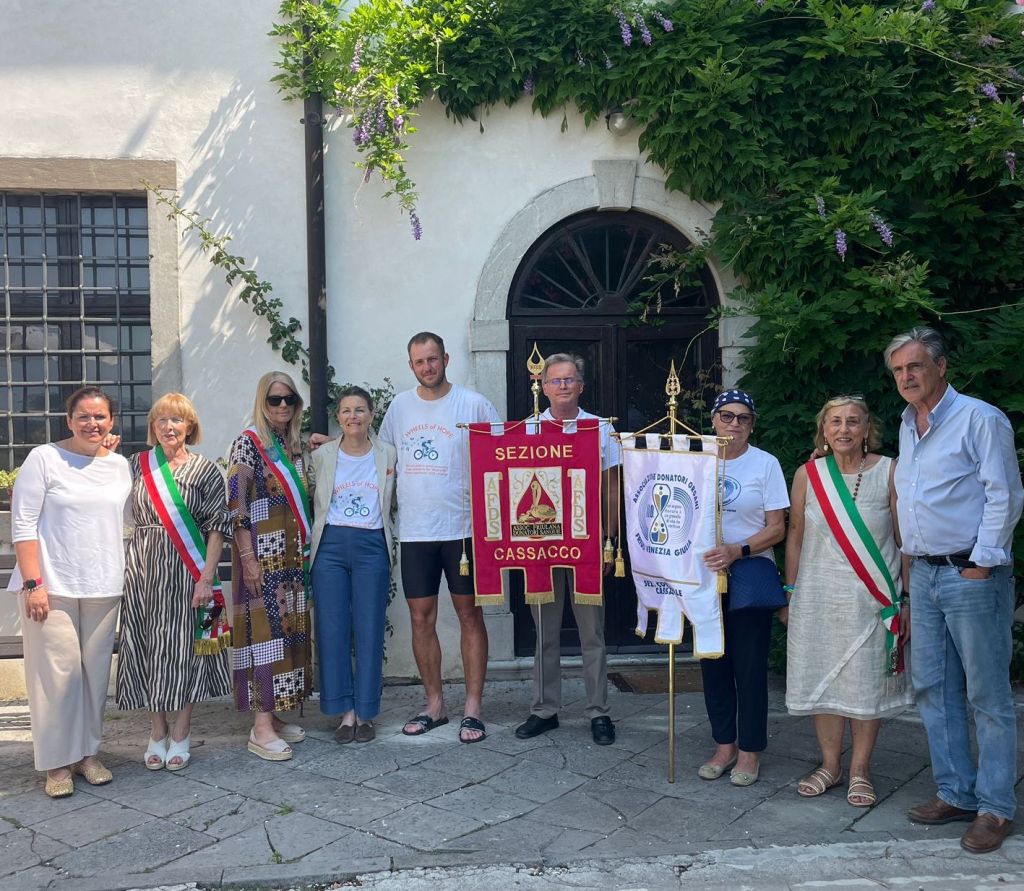
From left: The Friuli Venezia Giulia Transplant Coordinator Dr. Ivana Flore, the Mayor of Colloredo, Ms Renza Baiutti, the standing-in Mayor of Tricesimo, Ms Barbara Jannis, the President of the Alliance for Pulmonary Hypertension Pisana Ferrari, Lukas Jakovec, the representative of the Cassacco blood donor association AFDS, Mr Claudio Geretti, the representative of the Cassacco organ donor Association ADO, Mrs Gabriella Anzil, the Mayor of Cassacco, Ms Ornella Baiutti, Luigi Deciani, owner of Villa Gallici Deciani.
Lukas made a very touching speech, this is what he said:
Dear guests, friends, good morning. When I was here in October last year I had no idea what lay ahead of me. Today, after eight months of travel and over 22,000 kilometres, I am here in front of you again. And I want to thank you from the bottom of my heart for coming today to share this moment of my return. It has been an incredibly long journey, and at times a truly difficult one. But what made it extraordinary were the people. Both those online, and the people I met along the road, who welcomed me generously, opening their homes to me and helping me keep going. A huge thank you goes to the Alliance for Pulmonary Hypertension for their invaluable support. During the journey it was deeply moving to talk to people about organ donation. I met donors and people whose lives had been saved by a donated organ. Hearing their gratitude gave me incredible strength. It is wonderful to see how this cause concretely saves lives. I would also like to warmly thank Pisana, who handled all the organisation and was a fundamental pillar of support for me. Thank you also to Luigi for his hospitality at Villa Gallici Deciani. If this immense journey has taught me anything, it is that life is to be lived to the full and without unnecessary stress. It has shown me that no goal is out of reach and no dream is too far away, if you decide to get up and follow your heart. Finally, I thank the local mayors and authorities, all my loved ones, my family, and last but not least, my girlfriend, who stood by me and supported me from afar. Thank you all for your attention!
HIGHLIGHTS OF THE TRIP
1. The Route
Italy
The Italian leg alone took 42 days and covered the entire coastline, plus a full loop around Sicily. The standout climb was Mount Etna, thirty kilometres of continuous ascent at gradients up to 14% to the Silvestri Crater at 1,980m, with Helena Vondráčková playing in his headphones the whole way and free entry thanks to the campaign. Agrigento’s Valley of the Temples and the chalk-white cliffs of Scala dei Turchi left a strong impression, as did Pisa’s Leaning Tower — “another dream fulfilled.” Corsica delivered the single hardest stage of the whole journey, over 2,400m of climbing between Cargèse and Porto, while Bonifacio’s old town, perched on limestone cliffs, looked to him like it was “defying gravity.” In Sardinia he passed through the Blue Zone around Tortolì, known for the exceptional longevity of its inhabitants.
San Marino, Monaco & the Riviera
San Marino meant grinding from 10m to 800m above sea level on a fully loaded, 55kg bike — “good training”, he joked, after Andorra. Monaco, the world’s second most densely populated country, was crossed almost before he noticed it, and Toulon turned out to be France’s largest military port and main Mediterranean naval base.
Spain, Gibraltar & a Glimpse of Morocco
After days of flooding in southern France, crossing into Spain felt like a reset: “the sky turned blue, the clouds disappeared.” Gibraltar’s border crossing runs straight over the civilian airport runway, one of the few places in the world this happens; he skipped the paid summit but rode around the lighthouse in territory shared with wild Barbary macaques. From Tarifa, the southernmost point of mainland Europe, Africa was visible just 14 km away — close enough that his Czech mobile carrier welcomed him to Morocco before he’d decided not to cross. The 10,000 km mark fell near Cartagena, marked not by celebration but by a 70 km/h headwind that knocked him off his bike three times.
Portugal & the Camino
Crossing the Guadiana River into Portugal changed the country, the language and the time zone within the space of a bridge. He crossed the Douro in Porto via the Dom Luís I Bridge, and timed his arrival in Santiago de Compostela deliberately, to spend his birthday there near the cathedral that holds the legendary remains of St James. From Cape Finisterre — the Romans’ Finis Terrae, “the end of the world”, where pilgrims traditionally burn their old shoes — he wrote that he’d “burned at least all the hill pains” in his mind instead.
Northern Europe
The northern stretch ran through Brittany’s wild, lighthouse-studded coast and past Quistreham, one of the key D-Day landing sites; through Bruges, “the Venice of the North”, and Boulogne-sur-Mer, home to Europe’s largest aquarium; across the flat, fast roads of the Netherlands past historic windmills near the Zaan region still milling oil and cutting wood as they did centuries ago; along the Wadden Sea near Cuxhaven, where the tide retreats for kilometres; and past Magdeburg Cathedral, the first Gothic cathedral built in Germany. He finally crossed the Elbe near the Czech border at Schmilka, then rode home to Prague — arriving after 230 days, 20,700 km, and roughly 144,000m of climbing. At the very end of the campaign he attempted a 400 km ultra-distance race and “only” managed 160 km, a reminder, he wrote, that endurance racing asks for something quite different from months of touring.
2. Patients and the Awareness Mission
Lukáš made a point of stopping to meet transplant recipients and people living with lung disease along the way. In Fasano, Puglia, he met Angela, who lives with pulmonary hypertension; she invited him to her brother’s olive oil mill, where he tasted oil from trees over 500 years old, and he wrote that moments like this were the reason he was doing the trip at all. Near Pisa he visited a double-lung transplant patient and mountaineer, Alessandro, who had reached the base camps of K2, Nanga Parbat and Everest and completed expeditions in Greenland — twenty-three years after his transplant, Lukáš noted, Alessandro “still has more energy than half the cyclists on the road,” and his story “boosted me more than any espresso ever could.” In Sardinia, he pushed a 183 km day — a personal distance record — specifically to reach Marika, who is fighting lung disease, in Cagliari before nightfall; she hosted him at her home. In Sicily he met Filippa Rau directly through the Wheels of Hope campaign, an encounter he described as an honour. And in Brittany, connected through the website of association HTAP France — the French pulmonary hypertension patient group, a counterpart to AIPI within the same European network — Aurélie hosted him for breakfast, a hot shower, and time with her family and friends, which he called one of the moments that gave the whole journey real meaning.
These named meetings were really just the visible tip of a much wider effort. Lukáš describes stopping constantly along the route to talk to whoever crossed his path — on the cliffs of Étretat he wrote that an entire day became less about the kilometres and more about the people who stopped him, some donating, some simply offering a kind word; near Oye-Plage a chance conversation with locals over cola and tea became, in his words, “the real reason behind this entire journey”; and in Brittany a forced stop to find a power outlet turned into time well spent talking to strangers about organ donation. He also handed out printed information about the campaign wherever he could — at one stop in Italy, declining a host’s offer of a bed for the night, he left them a card about his trip before riding on. Over 230 days and hundreds of towns and villages, this kind of impromptu, constant outreach — far more often than not unrecorded by name — was as central to the campaign as the distance covered.
The message Lukáš repeated throughout the diary was simple and consistent: a single donor can save up to nine lives; organ donation after death gives a second chance to people who might not otherwise survive; and every bit of awareness, however small, counts. In his closing entry he thanked his family and girlfriend, the non-profit Alliance for Pulmonary Hypertension, its Secretary General Pisana Ferrari, and Luigi Deciani, owner of the Villa Gallici Deciani, where he had been living for a year and a half, and where he set out for his trip “for being with me right from the start.”
3. Kindness on the Road
One of the clearest threads running through the whole diary is how often complete strangers fed, sheltered or helped Lukáš, in almost every country he crossed. In Italy this ranged from a free kebab near Marco Polo airport to a restaurant owner in Porto Potenza Picena who invited him to staff dinner, another in Mattinata who brought him pizza, dessert and a local fruit before letting him sleep under his pergola, and a fruit-stall owner near Fasano who gave him free bananas and a bag of fresh focaccia simply because he asked nicely for three bananas. A stranger in Villa San Giovanni bought him coffee and paid for his ferry ticket to Messina outright — “what a legend,” as Lukáš put it. In Sant’Antioco, Sardinia, the owners of Hotel del Corso gave him a free bed, hot shower and food “from the heart, with no expectations,” while two mechanics opened their workshop on a holiday to fix his bike for nothing. In Corsica, a shopkeeper named Pierre filled his water bottle, made him a homemade sandwich and poured him local wine before letting him sleep in his garden — and the next morning in Ajaccio, what began as an awkward encounter with the police turned into an impromptu breakfast with the mayor of Ajaccio and several others.
France brought more of the same: coffee from locals near Toulon, an invitation to lunch from strangers near Quistreham that Lukáš noted “never gets old”, and, in Ghent, dinner from Czech and Slovak expats that turned out to be his only meal of an entire day when a public holiday closed everything else. In Spain, a Hungarian couple supported him at Barcelona’s airport while he charged his phone, a German couple invited him to lunch in the rain, and an Austrian expat near Dénia invited him for a bite. In Portugal a German expat invited him for a beer; in Belgium and the Netherlands, a family he’d met earlier in Antwerp had him back for dinner, a shower and a real bed; and in Germany, more than one stranger offered him a drink, a shower, or breakfast after he stopped only to charge his phone.
4. Storms, Harsh Conditions and the Realities of the Road
The weather turned genuinely dangerous more than once. Southern France and Spain flooded simultaneously at one point — Montpellier and Perpignan underwater, storms near Girona, snow in the Pyrenees — leading Lukáš to write simply: “Everything flooded. Everything hard. The weather went crazy… but the journey goes on.” Near Cartagena a 70 km/h headwind, the local Levante wind, knocked him off his bike three times, and further south a different storm destroyed the track ahead of him entirely, forcing a 10 km push across flooded sand. Storm Leonardo had snapped trees clean through days before he passed. Rally Corsica nearly swallowed his route near Calvi, with crashed rally cars being collected along the roadside as he rode past, and on Sicily’s Monte Cofano a path billed as a bike trail turned out to be a hiking trail over 600–700m cliffs — what should have taken thirty minutes took two hours of pushing his fully loaded bike, which he summed up as “Cyclist vs. Nature.”
The bike itself took a beating throughout. Thorn bushes near Lido Campomarino left both inner tubes with more than twenty holes each; his crank fell off twice within five kilometres in Calabria and was eventually fixed with a hammer rather than the wrench he’d bought for the job; and a rear wheel cracked in four places near San Vito Lo Capo, spokes barely holding.
Animals added their own chapter — five large dogs charged him in Calabria before police escorted him past, warning of fifteen more further down the road, while on two separate nights in Sicily, large dogs simply lay down beside him for warmth while he slept rough, and in Germany a cow on the dikes apparently decided to chase him for sport.
There were scarier moments too: a fly lodged in his ear in northern France led to a three-hour hospital wait, four doctors and an €80 bill, after which he rode half-deaf with traffic rushing past; a tense night near Tarifa saw a car circle his campsite repeatedly until he relocated twice, 15 km at a time, before finally pitching his tent at half past one in the morning; and a navigation error near San Benedetto del Tronto put him on seven kilometres of highway in the dark among honking traffic. Two separate evictions from “closed” beaches by motion-sensor alarms and security guards round out the list — one followed immediately, in his words, by the trip’s “first mosquito massacre.” Through all of it, the kindness described above kept showing up just when it was needed most.