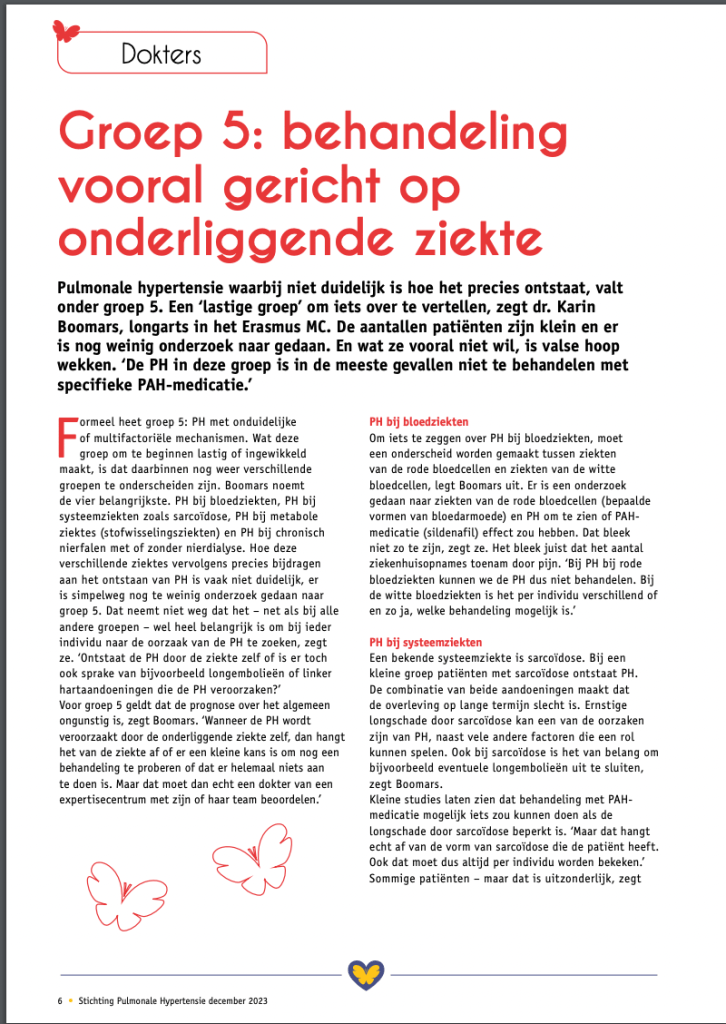
Louise Bouman, President of the Dutch Pulmonary Hypertension association, shared this article from the end-of-year edition of the association’s magazine “Papillon”. The article is about one of the five pulmonary hypertension groups classified by the World Health Organisation (WHO). Louise has also very kindly provided us with an English translation (see bottom of page for text in original language). Very big thank you Louise!
QUOTE
Pulmonary hypertension “with unclear and/or multifactorial mechanisms” falls under Group 5 of the World Health Organisation official classification. Dr. Karin Boomars, a pulmonologist at Erasmus MC, describes it as a “challenging group” to discuss due to the small number of patients and limited research. She emphasizes that in most cases, pulmonary hypertension in this group cannot be treated with specific pulmonary arterial hypertension medications.
This group is complicated by the presence of various subgroups. Dr. Boomars highlights the four main subgroups:
- PH related to blood diseases
- PH associated with systemic diseases such as sarcoidosis
- PH linked to metabolic diseases (metabolic disorders)
- PH in chronic kidney failure with or without kidney dialysis.
The exact contribution of these different diseases to the development of pulmonary hypertension is often unclear due to insufficient research in Group 5. Nevertheless, Boomars stresses the importance of investigating the cause of pulmonary hypertension in each individual, whether it is caused by the disease itself or other factors like pulmonary embolisms or left heart conditions.
Regarding the prognosis, Boomars notes that the outlook for Group 5 is generally unfavorable. If the pulmonary hypertension is caused by the underlying disease, the possibility of treatment depends on the specific disease, and a medical expert from a specialized center must assess whether any intervention is feasible.
PH related to blood diseases
Boomars explains that to discuss pulmonary hypertension related to blood diseases, a distinction must be made between diseases affecting red blood cells and those affecting white blood cells. Research on diseases affecting red blood cells, such as certain forms of anemia, and pulmonary hypertension did not show any effectiveness of pulmonary arterial hypertension medication (sildenafil). In fact, hospitalisations increased due to pain. Consequently, pulmonary hypertension in blood diseases affecting red blood cells cannot be treated. For diseases affecting white blood cells, the possibility and type of treatment vary individually.
PH associated with Systemic Diseases
Sarcoidosis is a well-known systemic disease that can lead to pulmonary hypertension in a small group of patients. The combination of both conditions results in poor long-term survival. Severe lung damage from sarcoidosis can contribute to the development of pulmonary hypertension, along with various other factors. Boomars emphasizes the importance of excluding potential pulmonary embolisms in cases of sarcoidosis. Limited studies suggest that pulmonary arterial hypertension medication may have some effect if lung damage from sarcoidosis is minimal. However, the suitability of treatment depends on the specific form of sarcoidosis in each patient.
PH related to Metabolic Diseases
This involves a very small group with rare disorders, with Gaucher’s disease being one of the mentioned diseases. In type 1 Gaucher’s disease, pulmonary hypertension can occur, often due to multiple causes. Accumulation of fat-laden immune cells in the blood vessels of the lungs may play a role. Treating the underlying disease with enzyme replacement therapy is crucial, and in individual cases, pulmonary arterial hypertension medication may have a positive impact.
PH in Chronic Kidney Failure
The Erasmus MC (Rotterdam) follows a relatively high number of patients with pulmonary hypertension and chronic kidney failure, mainly due to the center’s involvement in kidney transplants. However, since pulmonary hypertension in these patients is mostly caused by left-sided heart problems, the pulmonary hypertension in this group is also generally untreatable.
Conclusions
In summary, Boomars concludes that there is insufficient research on the use of pulmonary arterial hypertension medication in Group 5 for treatment. Moreover, the use of pulmonary arterial hypertension medication may sometimes worsen pulmonary hypertension. Therefore, treating the underlying disease is often the only viable option.
UNQUOTE