Access to health care is a broad and complex topic that warrants a clearer definition. What does is actually mean? Is it simply the provision of health services and medicines? An article titled “Access in the rare diseases landscape”, published in The Lancet Global Health October 2024 edition, delves into the different aspects that define access for individuals living with rare diseases, exploring the multifaceted components including research, regulation, geography, sociology, economy and education.
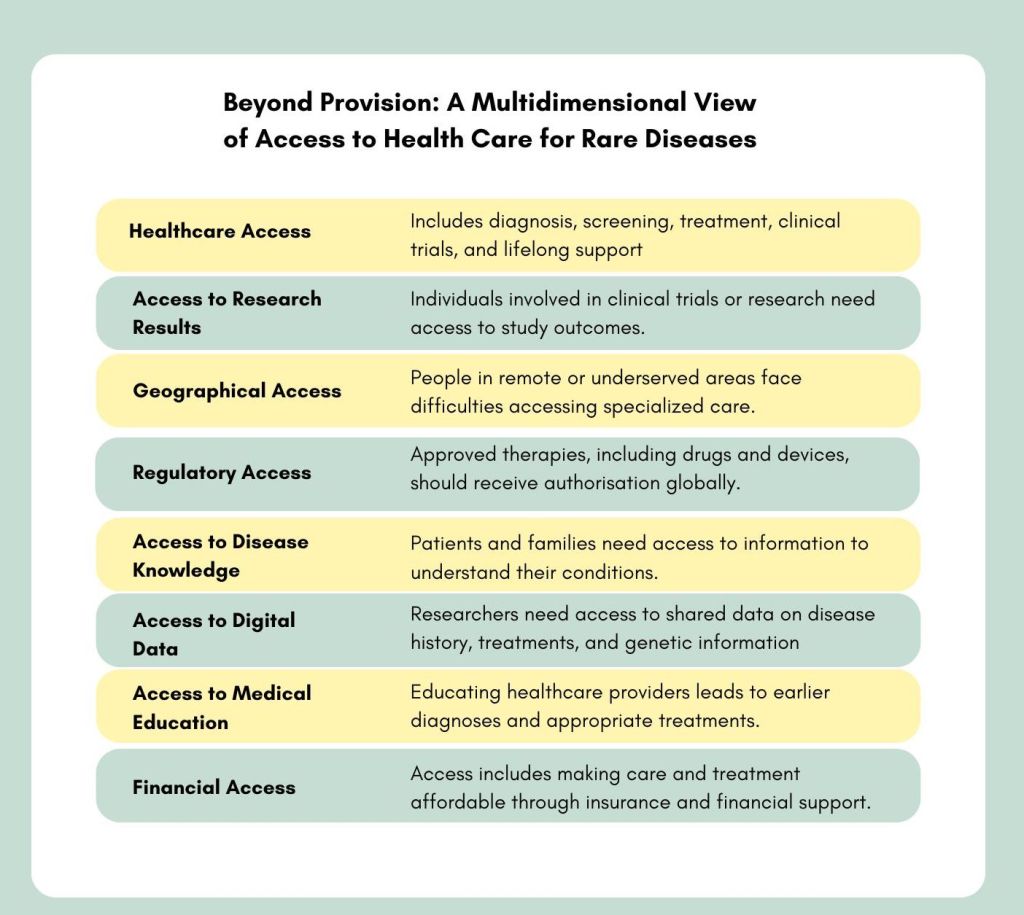
We have summarised the article in bullet points as follows and also in an infographic (see below, developed with Canva).
Healthcare Access:
Access to health care includes diagnosis, screening, treatment, clinical trials, and lifelong support
Access to Research Results:
Individuals involved in clinical trials or research need access to study outcomes.
Geographical Access:
People in remote or underserved areas face difficulties accessing specialized care. Telehealth and travel support can help to bridge the gap.
Regulatory Access to Treatments:
Approved therapies, including drugs and devices, should receive authorisation globally.
Access to Disease Knowledge:
Patients and families need access to information to understand their conditions.
Access to Digital Data:
Researchers need access to shared data on disease history, treatments, and genetic information to drive collaboration.
Access to Medical Education:
Educating healthcare providers about rare diseases leads to earlier diagnoses and appropriate treatments.
Financial Access to Care:
Access includes making care and treatment affordable through insurance and financial support.
The article is open access and can be found at this link
Citation
Anneliene H Jonker, Maria Cavaller-Bellaubi, Yukiko Nishimura, David A Pearce,
Access in the rare diseases landscape, The Lancet Global Health, Volume 12, Issue 10, 2024, Page e1587, ISSN 2214-109X, https://doi.org/10.1016/S2214-109X(24)00341-3.
(https://www.sciencedirect.com/science/article/pii/S2214109X24003413)